A parent dies, and the will is not what anyone expected.
That is where most estate disputes begin — with a document that doesn’t match the person you knew. Russell J. Fishkind and Ronald P. Colicchio have spent three decades in that room, representing families and fiduciaries in contested wills, trusts, gifts, accountings, and guardianships.
Does any of this sound familiar?
Most people who call us aren’t sure whether what happened is actually a legal problem. Usually they describe it in one of these ways.
“The will changed at the very end.”
A new will or codicil appears in the final weeks or months, often favoring whoever was closest by. Undue influence claims examine who was in the room, who drove to the lawyer, and who benefited.
Undue influence →“He wasn’t himself when he signed it.”
Dementia, medication, a hospital bed. Capacity cases are built from medical records, pharmacy histories, and the testimony of the people who saw him that week.
Lack of capacity →“The accounts were emptied before the funeral.”
Beneficiary changes, joint titling, powers of attorney, transfers made months before death. What passes outside the will can matter more than the will itself.
Contested gifts & transfers →“The executor won’t show us anything.”
Beneficiaries are entitled to an accounting. When one isn’t produced, or when the numbers don’t reconcile, the remedy runs from a compelled accounting to removal.
Accountings & removal →“A guardian was appointed and no one told us.”
Guardianship contests decide who controls an incapacitated person’s care, home, and money — often while the family is still arguing about what she would have wanted.
Contested guardianships →“The trustee is running the money into the ground.”
Breach of fiduciary duty claims reach investment decisions, self-dealing, unequal distributions, and fees charged against a trust that beneficiaries never agreed to.
Trust litigation →Four stages, and most cases end before the last one.
Estate litigation follows a defined path through the Surrogate’s Court or Chancery Division. Knowing the order of it makes the next year far less frightening.
The conversation
You tell us what happened. We tell you plainly whether there is a claim, what it would cost, and what the realistic range of outcomes looks like.
The record
Medical charts, bank and brokerage statements, the drafting attorney’s file, caregiver notes. Most disputes are won or lost in what the documents show.
Filing and discovery
A complaint or caveat, then depositions of the people who were there. This is where accounts of the same events start to diverge on the record.
Resolution
Mediation, settlement, or trial. Courts push these cases toward mediation, and families often prefer it — but the case has to be built as if it will be tried.
Two lawyers who have spent careers on these cases.

Russell J. Fishkind, Esq.
Russell has represented clients in contested estates for more than thirty years, in New Jersey, New York, and matters reaching well beyond them. He is an Assistant Adjunct Professor at New York University, a frequent speaker to bar associations and estate planning councils, and the author of Probate Wars of the Rich & Famous: An Insider’s Guide to Estate Planning and Probate Litigation.
He represents individual beneficiaries, executors and trustees, and corporate fiduciaries — including families whose disputes involve closely held businesses, multi-state property, and substantial estates.

Ronald P. Colicchio, Esq.
Ronald earned both his law degree and a Master’s in Taxation at New York University School of Law. He is admitted in New York, New Jersey, and Florida, and has handled estate and trust matters for more than thirty years — undue influence and capacity claims, contested inter vivos transfers, beneficiary designation disputes, contested accountings, breach of fiduciary duty, and Power of Attorney actions.
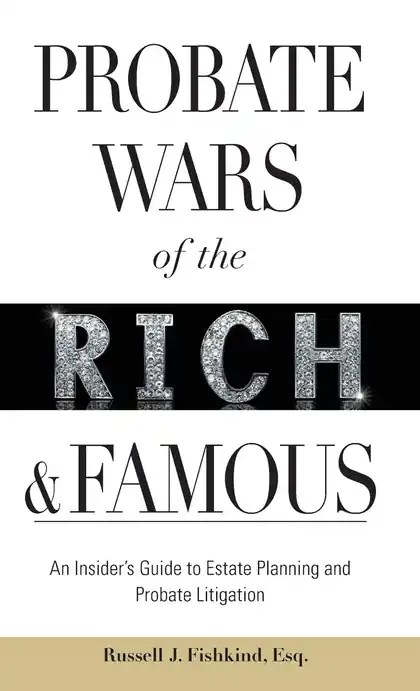
The same questions, in the estates you’ve read about.
Probate Wars traces the estate battles of Anna Nicole Smith, Brooke Astor, Michael Jackson, Nina Wang, Jerry Garcia, and Leona Helmsley, and identifies the five factors that caused every one of them. The same five show up in ordinary families.
- Articles & legal references — statutes, leading cases, and commentary, in the articles library.
- The estates themselves — read the Brooke Astor, Michael Jackson, and Leona Helmsley case studies.
- Video series — plain-language explanations of undue influence, joint accounts, and guardianship in the video library.
- Court & resource links — Surrogate’s Courts and Chancery Divisions in the resources section.
Tell us what happened.
Write it the way you’d explain it to a friend — when the person died, what the will or trust says, and what feels wrong about it. One of us will read it and respond personally. A first conversation is a conversation, not a commitment.
Start here